


Can Baking Soda Fight the Effects of Altitude?
(Photo: Abigail Wise, Canva)
Published February 25, 2026 01:21PM
Here’s a series of statements that exercise scientists mostly believe are true:
- During hard exercise, when your muscles are starved of oxygen, your metabolism shifts to produce energy in ways that make your muscle cells more acidic.
- This rising acidity contributes (in various ways that are still up for debate) to muscle fatigue.
- Ingesting baking soda, which is a base, helps to counteract the rising acidity and reduce the associated muscle fatigue.
- At high altitudes, lower levels of oxygen in the air mean that your muscles start going acidic sooner than they otherwise would, making exercise at altitude harder.
Those first three statements, taken together, are the reason that baking soda has emerged as one of the hottest legal performance-boosters among endurance athletes over the last few years. The fourth statement is a logical extension, suggesting that baking soda might be particularly valuable for, say, climbing mountains or cycling over alpine passes. A recent study from a research team led by Eli Spencer Shannon of Edge Hill University in Britain, published in the European Journal of Applied Physiology, tests this claim. The results are positive, but with a catch.
The Baking Soda Backstory
The potential performance benefits of baking soda, a.k.a. sodium bicarbonate, have been understood and studied for half a century now, but its unpredictable and unfortunate side effects—nausea, flatulence, even diarrhea—meant that it was a relatively niche product until recently.
In 2023, the Swedish company Maurten introduced a formulation that encapsulates the baking soda into minitablets suspended in a special hydrogel. These minitablets pass through the stomach unscathed, minimizing digestive side-effects, then release the baking soda in the intestine where it can be absorbed into the bloodstream. There have been a few studies suggesting that Maurten’s version does indeed minimize GI problems and enhance endurance performance—not a huge body of evidence, but enough to buttress the widespread anecdotal tales of elite athletes relying on it.
The idea that baking soda might be particularly helpful in the low-oxygen environment at high altitudes doesn’t come out of nowhere. Several studies have tested it, with mixed results. Those studies focused on relatively short bursts of exercise: repeated sprints, or cycling trials lasting up to about five minutes. That’s because muscle acidity is thought to have its greatest effects for efforts lasting between about one and ten minutes.
But one of the most striking facts of the new baking soda era is that athletes are using it for far longer efforts. Kilian Jornet, the incomparable mountain ultramarathoner, swears by it. Tour de France cycling teams were among the first adopters. Joshua Cheptegei, who holds the world records for 5,000 and 10,000 meters on the track, used it. So what’s particularly interesting about Shannon’s new study is that it tests cyclists in a 40K cycling time trial, which takes about an hour: a true test of endurance.
The New Study
Shannon and his colleagues recruited 14 trained cyclists to complete a series of three 40K time trials: one to familiarize themselves with the setup, one with Maurten’s baking soda, and one with a minipill-and-hydrogel placebo supplied by Maurten that looks and tastes identical to the real thing. All the trials were performed in an altitude chamber set to simulate the oxygen levels at 1,850 meters (6,000 feet) above sea level.
Here’s what the individual and average times for the baking soda (NaHCO3) and placebo trials looked like:
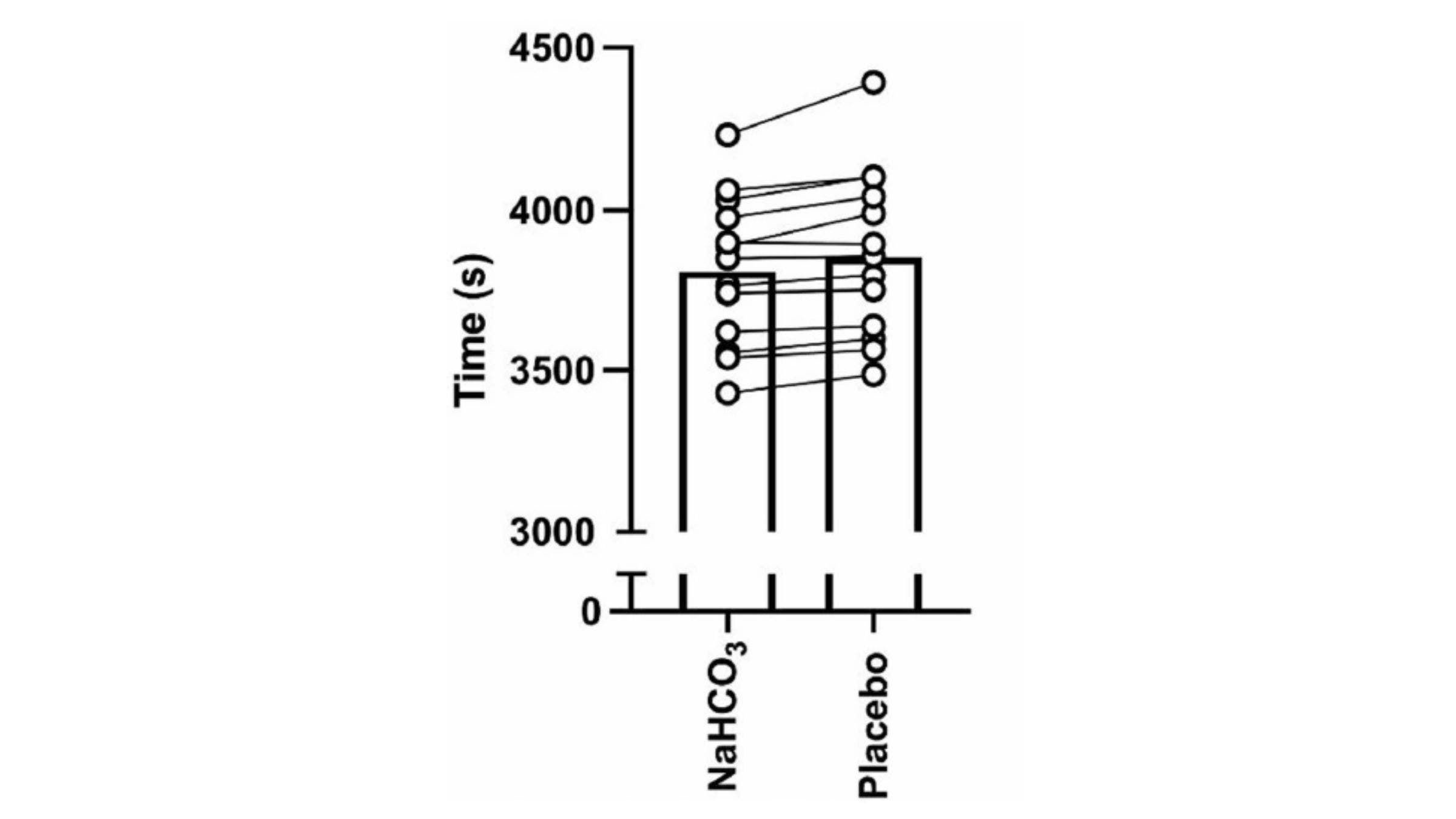
The average time of 63:29 with baking soda was 1.2 percent faster than the 64:15 with placebo—a statistically significant difference. And the individual data points show that almost every subject was equal or faster with baking soda. That’s a remarkably consistent effect, given that the knock on baking soda was always the risk of horrendous gastrointestinal side effects. They did do a detailed assessment of GI symptoms, which were next to nil in both groups, with no significant differences.
The pacing breakdown is also interesting. Here’s the mean power for each of the time trial’s four quarters, with the baking soda trial shown with circles and the placebo shown with squares:
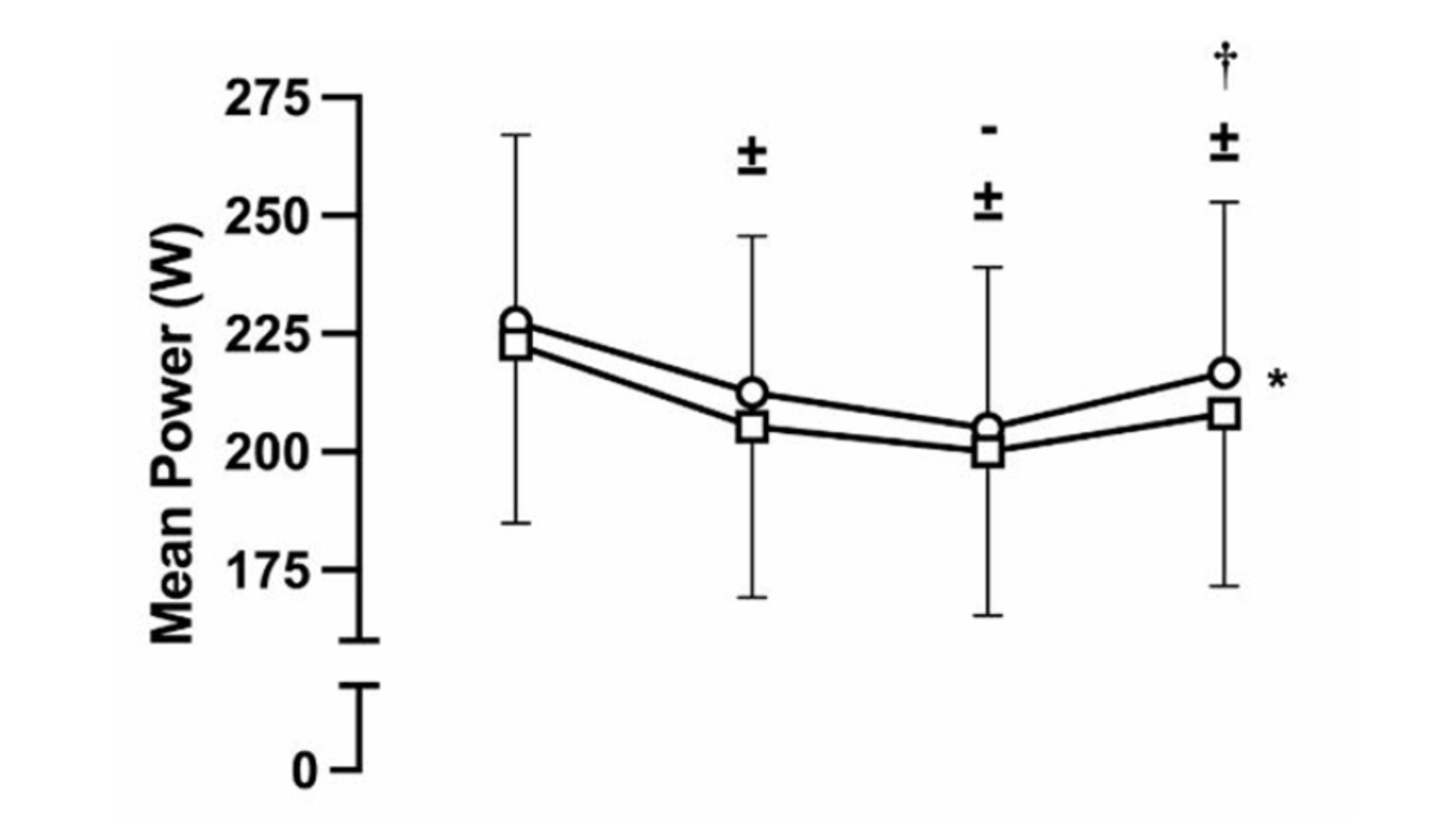
What’s notable is that the baking soda advantage is small but consistent. It doesn’t just show up in the finishing kick at the end. One of the theories for why Grand Tour cyclists and ultrarunners like Jornet might benefit is that it would help for short bursts: breakaways from the peloton, or steep climbs up a mountain. But here baking soda seems to be providing a persistent edge over the course of the whole hour.
So does this mean that baking soda is the new miracle anti-altitude supplement—better than, say, ketones? Not so fast. Shannon’s previous study used a nearly identical protocol to test the effects of Maurten’s baking soda on 40K time trial performance at sea level. In that case, he found a 1.4 percent improvement, suggesting that baking soda works marginally less well at altitude than at sea level.
The two studies weren’t identical. In the sea level study, each subject underwent a pre-test to determine exactly how long it took to reach peak bicarbonate levels in their blood after taking the baking soda, and then timed their pre-time trial dose accordingly. In the altitude study, for simplicity, they gave everybody their dose (0.3 grams of baking soda per kilogram of body weight) exactly 90 minutes before the time trial. As a result, blood bicarbonate levels during the cycling test were a little lower in the new study, which might explain the differences.
Still, what I take away from this study isn’t that baking is uniquely useful at altitude. It’s that we have another piece of evidence that (a) baking soda enhances performance not just for short middle-distance events but also for steady efforts lasting an hour, and (b) taking it in the form of a hydrogel suspension mostly seems to avoid the gastrointestinal disasters of the past. Both of these claims have been the topic of spirited debate in the endurance world over the last few years, and those debates will continue—but the case in favor of baking soda just got a little stronger.
For more Sweat Science, sign up for the email newsletter and check out my new book The Explorer’s Gene: Why We Seek Big Challenges, New Flavors, and the Blank Spots on the Map.